
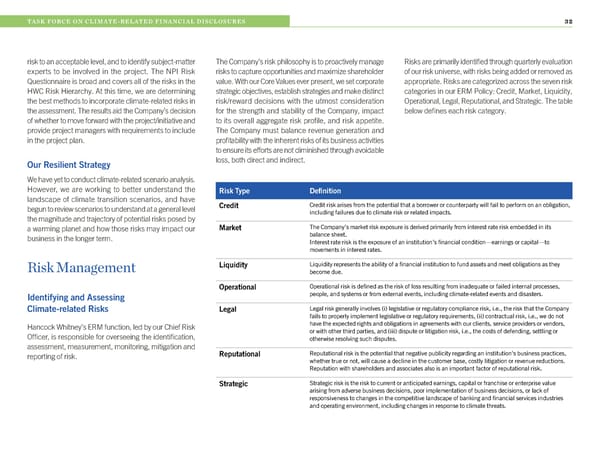
TASK FORCE ON CLIMATE-RELATED FINANCIAL DISCLOSURES 32 risk to an acceptable level, and to identify subject-matter The Company’s risk philosophy is to proactively manage Risks are primarily identified through quarterly evaluation experts to be involved in the project. The NPI Risk risks to capture opportunities and maximize shareholder of our risk universe, with risks being added or removed as Questionnaire is broad and covers all of the risks in the value. With our Core Values ever present, we set corporate appropriate. Risks are categorized across the seven risk HWC Risk Hierarchy. At this time, we are determining strategic objectives, establish strategies and make distinct categories in our ERM Policy: Credit, Market, Liquidity, the best methods to incorporate climate-related risks in risk/reward decisions with the utmost consideration Operational, Legal, Reputational, and Strategic. The table the assessment. The results aid the Company’s decision for the strength and stability of the Company, impact below defines each risk category. of whether to move forward with the project/initiative and to its overall aggregate risk profile, and risk appetite. provide project managers with requirements to include The Company must balance revenue generation and in the project plan. profitability with the inherent risks of its business activities to ensure its efforts are not diminished through avoidable Our Resilient Strategy loss, both direct and indirect. We have yet to conduct climate-related scenario analysis. However, we are working to better understand the Risk Type Definition landscape of climate transition scenarios, and have Credit Credit risk arises from the potential that a borrower or counterparty will fail to perform on an obligation, begun to review scenarios to understand at a general level including failures due to climate risk or related impacts. the magnitude and trajectory of potential risks posed by a warming planet and how those risks may impact our Market The Company’s market risk exposure is derived primarily from interest rate risk embedded in its business in the longer term. balance sheet. Interest rate risk is the exposure of an institution’s financial condition—earnings or capital—to movements in interest rates. Risk Management Liquidity Liquidity represents the ability of a financial institution to fund assets and meet obligations as they become due. Operational Operational risk is defined as the risk of loss resulting from inadequate or failed internal processes, Identifying and Assessing people, and systems or from external events, including climate-related events and disasters. Climate-related Risks Legal Legal risk generally involves (i) legislative or regulatory compliance risk, i.e., the risk that the Company fails to properly implement legislative or regulatory requirements, (ii) contractual risk, i.e., we do not Hancock Whitney’s ERM function, led by our Chief Risk have the expected rights and obligations in agreements with our clients, service providers or vendors, Officer, is responsible for overseeing the identification, or with other third parties, and (iii) dispute or litigation risk, i.e., the costs of defending, settling or otherwise resolving such disputes. assessment, measurement, monitoring, mitigation and reporting of risk. Reputational Reputational risk is the potential that negative publicity regarding an institution’s business practices, whether true or not, will cause a decline in the customer base, costly litigation or revenue reductions. Reputation with shareholders and associates also is an important factor of reputational risk. Strategic Strategic risk is the risk to current or anticipated earnings, capital or franchise or enterprise value arising from adverse business decisions, poor implementation of business decisions, or lack of responsiveness to changes in the competitive landscape of banking and financial services industries and operating environment, including changes in response to climate threats.
 2022 Hancock Whitney ESG Report Page 31 Page 33